DATA AND AI GOVERNANCE FORUM HELD
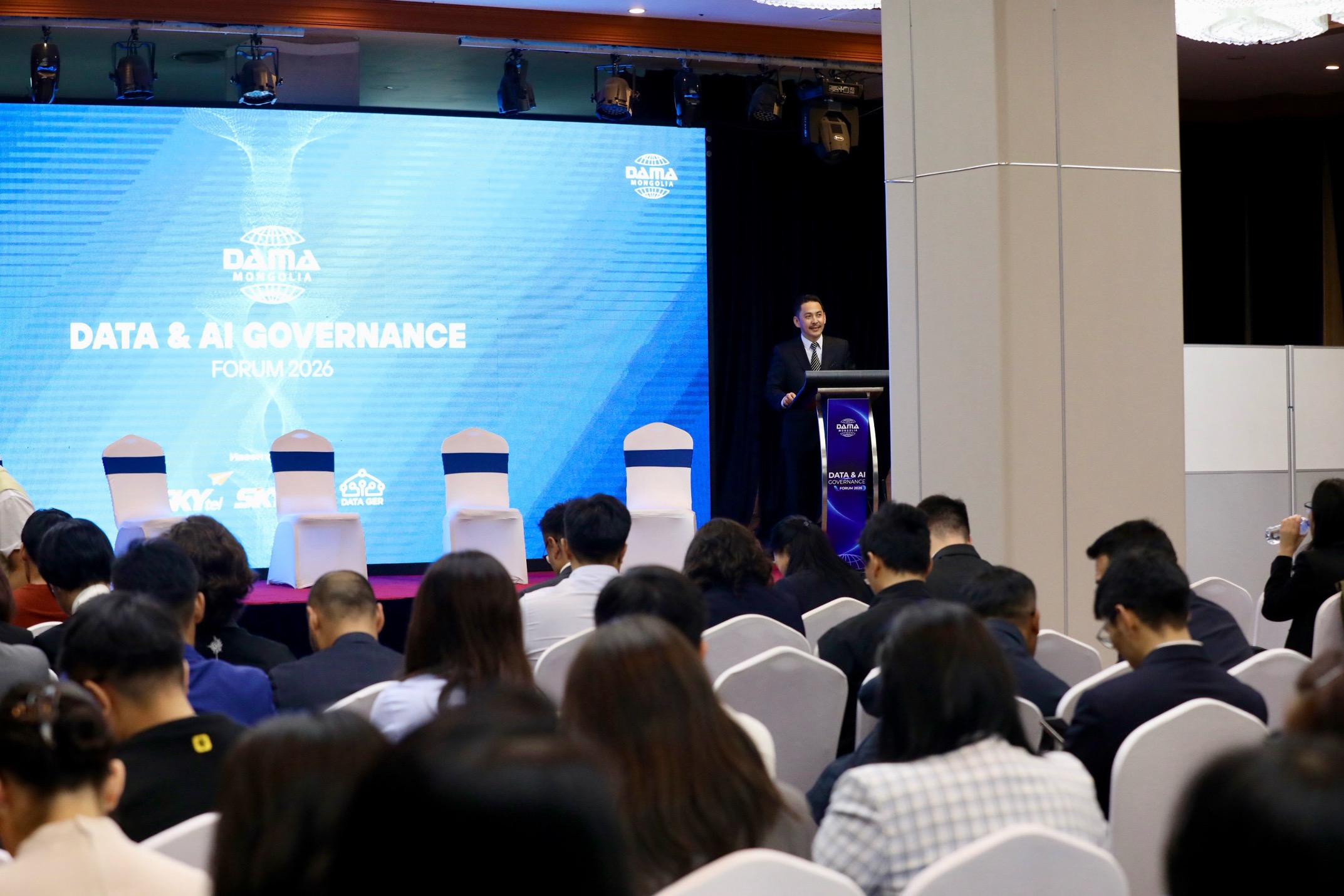
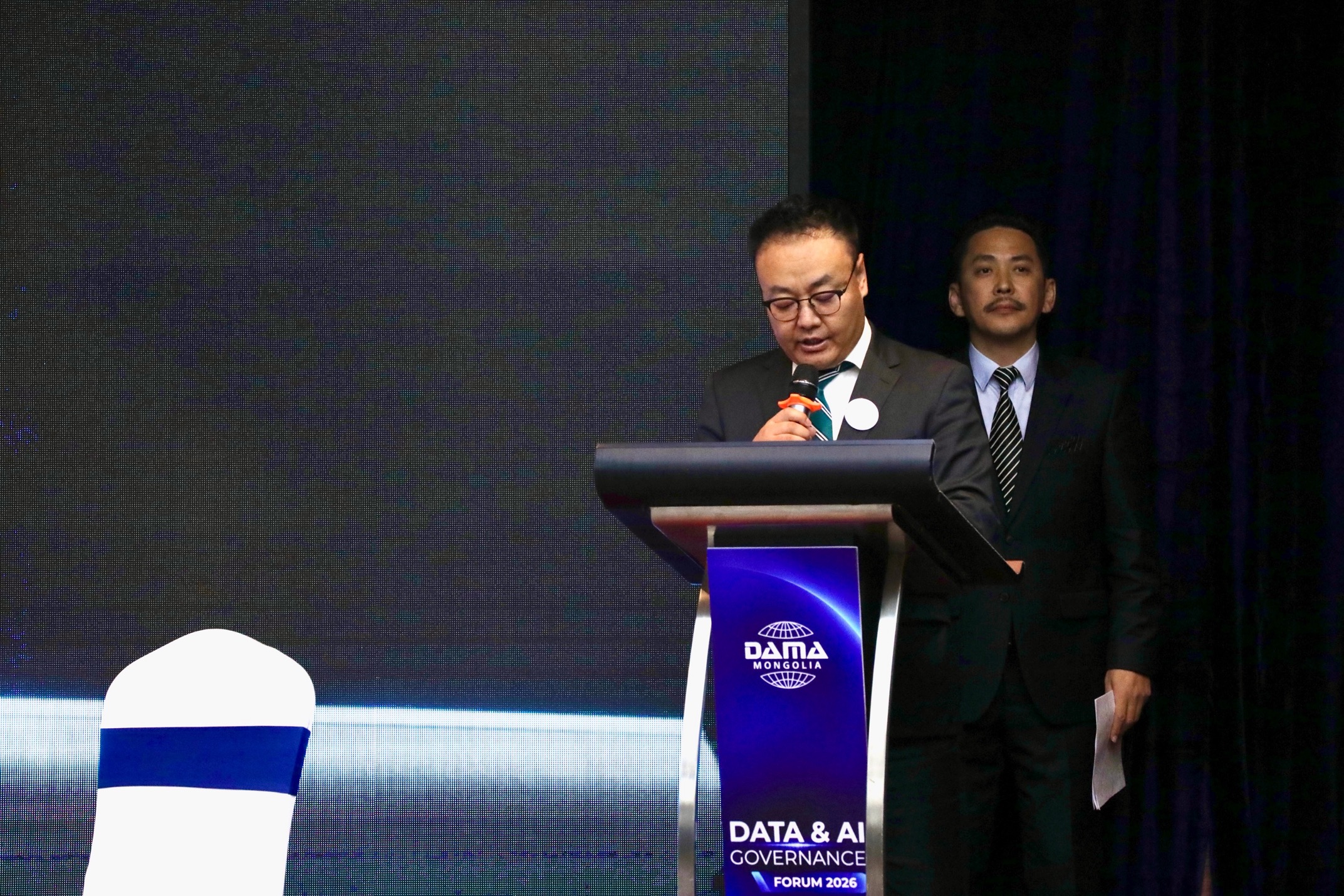
The Ministry of Digital Development, Innovation and Communications and DAMA Mongolia Chapter jointly organized the DATA & AI GOVERNANCE FORUM 2026 on 18 September 2026 under the theme “Govern Your Data.” As Mongolia’s first cross-sector forum to address data and AI governance comprehensively, the event brought together executives, policymakers, regulators and professionals from government, banking, telecommunications, mining and AI development organizations.
The forum lasted more than four hours, and all panel discussions were recorded in full. We reviewed and consolidated the key themes, perspectives and conclusions raised throughout the sessions. The following section presents the principal findings from the edited summary.
Key findings repeated across all five panels
Representatives from banking and finance, telecommunications, mining, government and artificial intelligence participated in five panel discussions throughout the day. Although these sectors have distinct mandates and operating environments, several themes emerged consistently across nearly every panel.
1. The principal challenges are organizational rather than technological
The observation that “the technical capabilities are already in place” was repeated across the panels. Banks have developed the technical foundations for open banking; telecommunications operators have been using data-driven solutions since 2013–2014; Erdenet Mining Corporation has introduced AI into its production processes; and universities have begun consolidating their research data.
The 10/20/70 principle discussed during the AI panel summarized this conclusion particularly well: 10 percent of success depends on the model, 20 percent on the technology stack, and 70 percent on people, processes and organizational structures. Most of the challenges discussed throughout the forum fell within this 70 percent.
2. The legal framework is lagging, leaving sectors in a holding pattern
In four of the five panels, participants identified the adoption of the Data Law as the most important step to be taken within the next 12 months. The absence of this law is producing tangible consequences:
- Banks cannot expand the scope of open banking services because the rules governing consent and data transfers remain unclear.
- Telecommunications operators are reluctant to exchange data across sectors because of the associated legal and compliance risks.
- Opportunities to reuse exploration data in the mining sector remain limited.
- Start-ups are unable to access the data needed for research and development.
3. A shortage of skilled professionals is common across all sectors
Banks are developing specialists internally; the mining sector lacks sufficient knowledge-management capacity; government institutions face a shortage of AI professionals; and several panels noted that universities are not yet able to supply enough work-ready specialists.
In response, the banking sector is adopting the data steward model. Under this approach, a relatively small team of data professionals provides central expertise, while responsibility for data is assigned to employees within each business unit.
4. Responsibility for data governance is shifting to the business
The principle that data should be owned and governed by the business, as set out in DAMA-DMBOK, was clearly articulated during the banking panel and echoed by representatives from other sectors.
Under this model, the information technology function serves as an implementer and enabler. The data management function acts as a “translator and bridge” between business and technology, helping convert business needs into governance requirements and practical solutions.
5. Consent was the most frequently raised unresolved issue of the day
The moderator of the telecommunications panel framed the issue clearly: “Is obtaining consent sufficient, and what level of consent is required?”
The same question arose in different forms across the banking panel in relation to open banking, the telecommunications panel in relation to cross-sector data exchange, the government panel in relation to access to citizens’ information, and the AI panel in relation to the use of data in AI models.
Policy recommendations arising from the discussions
The specific recommendations raised across the sectors can be summarized as follows:
Legal and regulatory framework
- Enact Mongolia’s first standalone Data Law during the autumn session of the State Great Khural. This was a shared recommendation from representatives of the banking and telecommunications sectors and regulatory authorities.
- Adopt the National Strategy for Big Data and Artificial Intelligence. In the absence of an approved national strategy, private-sector organizations lack a common foundation on which to develop their own policies.
- Define who is authorized to certify that data has been anonymized and establish the applicable assessment criteria. This regulatory gap is discouraging companies from exchanging data.
- Standardize open-data licensing terms nationwide.
- Establish a legal basis for opening mining exploration data after a defined period or making it available for research purposes.
- Define the conditions under which operators of critical information infrastructure may use cloud technologies, provided that applicable security requirements are met.
Standards and organizational performance
- Move data governance beyond voluntary practice by establishing standards applicable to all organizations. This recommendation was raised by the Bank of Mongolia.
- Require government institutions to follow approved national classifications and link data quality to organizational performance assessments. This recommendation emerged from the government panel.
- Require every organization to designate an officer responsible for data governance. This recommendation was also raised during the banking panel.
- Adapt and implement relevant international standards in Mongolia.
AI governance
- Define clear, non-negotiable “red lines” for the development and use of AI.
- Allocate governance responsibilities between AI model developers and organizations that deploy or use those models.
- Establish audit logging as a minimum requirement when using external AI models.
- Provide domestic start-ups with access to open testing environments or regulatory sandboxes within public procurement processes.
| Sector Strengths Main constraints | ||
| Banking and finance | Governance structures, standards and data steward systems | Open banking and consent requirements |
| Telecommunications | Demonstrated economic value from data and more than ten years of practical experience | Lack of a clear legal basis for cross-sector data exchange |
| Mining | High-value long-term datasets and practical deployment of AI | Paper-based archives and unclear data ownership |
| Government | E-Mongolia, data-access notifications and open microdata | Duplication and inconsistent classification standards |
| Artificial intelligence | Active private-sector participation and emerging professional training | National strategy not yet adopted |
Summary
The discussions showed that organizations in data-intensive sectors, including banking, telecommunications and mining, have implemented data governance at different levels and accumulated practical experience. However, the need to improve cross-sector data exchange, common standards, legal regulation and institutional coordination was shared across the sectors.
It is therefore important that the Data Law and the National AI Strategy reflect the sectors’ practical experience, needs and implementation capacity. A coherent policy framework and clear regulations would support the safe, responsible and effective use of data and artificial intelligence.
Organized by: DAMA Mongolia Chapter and the Ministry of Digital Development, Innovation and Communications
Sponsored by: Skytel, Skymedia and Data Ger